

Hospitalisation leave: when can it start according to the Supreme Court
Key aspects of the new criteria on the start of hospitalisation leave
The Supreme Court has issued a relevant ruling regarding paid leave for serious illness, hospitalisation or surgical intervention of family members. Judgment No. 126/2026, dated 4 February, confirms the previous ruling of the National Court and clarifies a key aspect of Article 37.3.b) of the Workers’ Statute: the leave does not have to begin on the same day as the triggering event or on the following working day.
This criterion represents a significant shift in business practice and reinforces the care-related purpose of the leave.
1. Background of the case
The dispute arose following the publication, by a corporate group, of an internal policy stating that the leave had to begin without exception on the first working day following the triggering event, as well as establishing other mandatory criteria not предусмотрed by law.
Trade unions challenged this policy on the grounds that it unjustifiably restricted a statutory right, and the National Court ruled in their favour. The company subsequently appealed to the Supreme Court.
2. What does the Supreme Court say?
The Court structures its decision around three key ideas:
a) The Workers’ Statute does not determine the start date of the leave
Article 37.3.b of the Workers’ Statute grants the right to be absent for five days but does not specify when the leave must begin, nor does it require it to start immediately after the event.
b) The purpose of the leave is to provide care, not to meet a specific date
The Supreme Court emphasises that this leave has a care-related purpose: to allow the employee to attend to an ill family member.
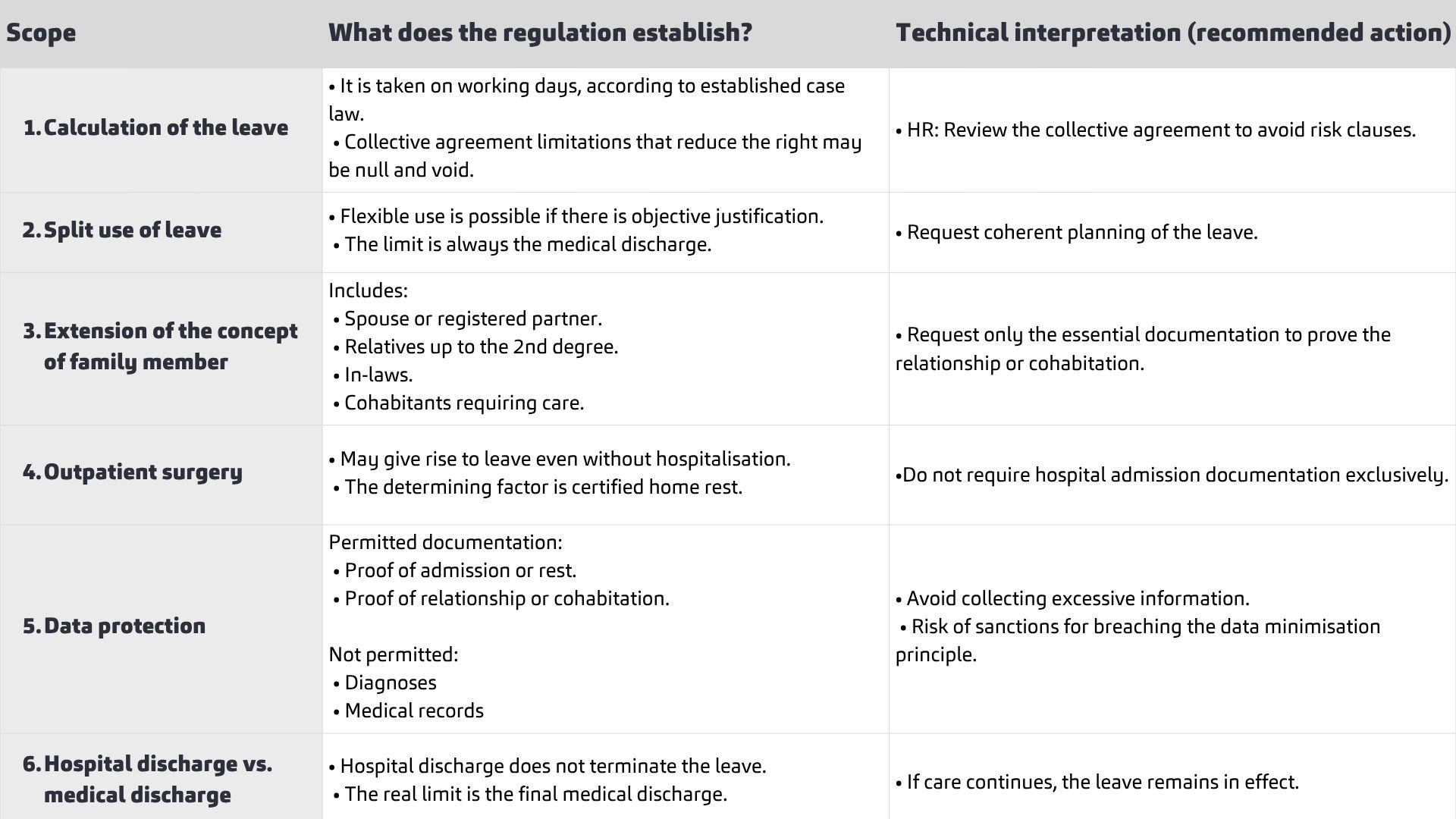
This need for care does not end on the day of the triggering event and may extend over a longer period. Hospital discharge does not automatically terminate the leave. The actual limit is the final medical discharge.
c) It is not valid to impose restrictions not provided for by law
The company cannot, through an internal policy, require the leave to start on a specific date when neither the law nor the applicable collective agreement establishes this.
3. How does this ruling affect business management?
The decision has direct implications for all organisations:
- Flexibility in the start of leave: The employee may choose when to begin the leave, provided that the need for care continues.
- Obligation to adapt internal policies: Companies cannot impose restrictions on start dates that are not supported by law or collective agreement.
- Importance of justification: The right must still be communicated and evidenced, but the company cannot require additional documentation not предусмотрed by law.
- Avoiding disputes and litigation: Maintaining restrictive criteria may lead to individual claims or even collective actions.
Conclusion
Supreme Court Judgment No. 126/2026 reaffirms that leave under Article 37.3.b of the Workers’ Statute must be interpreted in light of its care-related purpose, rather than from a formalistic perspective. Therefore, the leave does not have to begin on the day of the event, but rather when it is most appropriate to address the care needs of the affected family member.
The ruling requires companies to adopt more flexible and legally compliant policies, strengthening work-life balance and avoiding restrictions not provided for by law.
Key points to consider when managing this type of leave:
Related content


